…delivers the scares
everyone craves
in October
A Creepy, Feminist Sequel
Thoughts by Jen Howell
If you’re a fan of “Scream”, you’ve probably at least heard of, if not seen, the 1979 film “When a Stranger Calls.” While it’s not the only 70s horror movie where “the call is coming from inside the house” (1974’s “Black Christmas” got there first), its legendary, terrifying opening sequence is cited as one of the inspirations for “Scream”, and therefore a necessary watch for true horror fans.
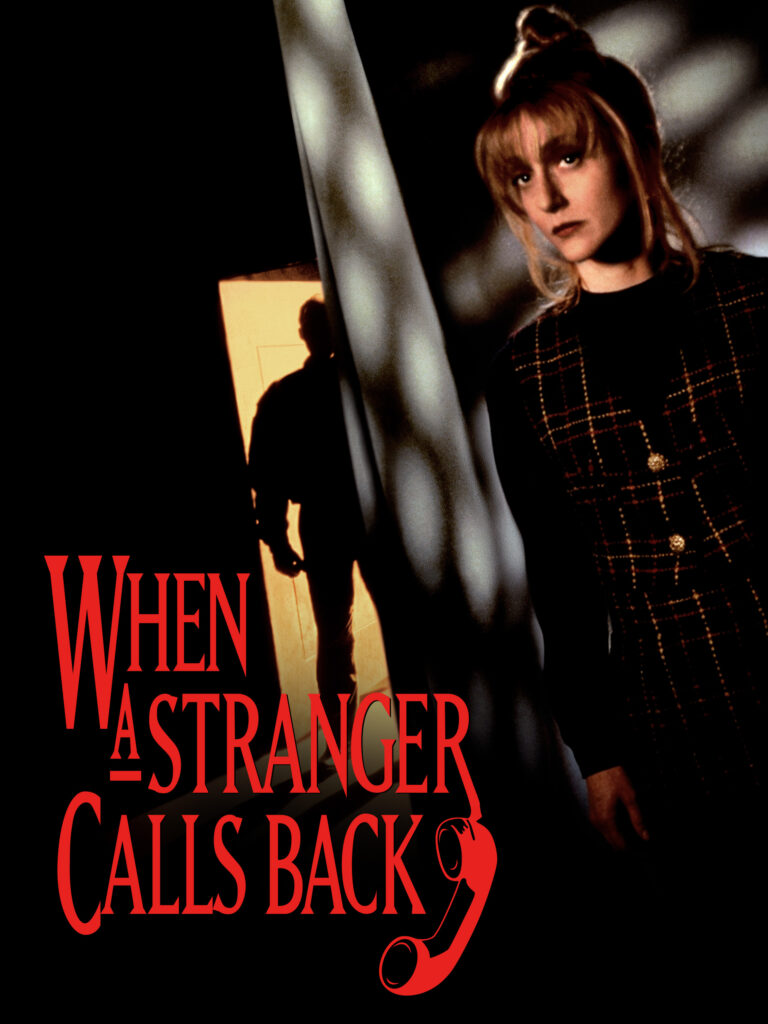
But while most horror fans have seen “Scream”, and many have seen “When a Stranger Calls” or even its 2006 remake, very few have seen the 1993 made-for-TV sequel “When a Stranger Calls Back.” And that’s a shame – because in my opinion, it’s scarier than the original, and it packs a fair amount of feminism into its 94-minute runtime! And while I would recommend also watching the original, I saw the sequel first, and had no trouble enjoying it!
“When a Stranger Calls Back” was written and directed by Fred Walton, who helmed the first film, and brings back Carol Kane and Charles Durning, this time in supporting roles. Heading up the new film is Jill Schoelen, who plays Julia as both a high school girl and later a college student.
The film opens similarly to “When a Stranger Calls.” Julia is on a babysitting job when she’s menaced by a strange man – this time, seemingly, at the front door. The scares and tension build gradually, as first she notices the phone line has been cut, and then sees that objects inside the house have been tampered with, leaving her confused as to where the threat is coming from. By the end of the scene, the children have vanished without a trace, and Julia is left traumatized.
The middle of the film finds Julia at college, where, after a lapse of many years, she’s realized that she may not be safe in her apartment. Objects have been moved around, an alarm that she didn’t set wakes her up in the middle of the night, and finally a children’s shirt appears in her closet. When she goes to the police, they write her off as a “hysterical coed”, and she must instead rely on the help of Jill Johnson (Carol Kane), now the head of Women’s Services at her campus. Jill in turn brings in John Clifford (Charles Durning), the police officer who investigated the killer in the first movie.
The film is full of subtle feminist commentary. When Julia is disbelieved by male officers at the local police department, Jill speaks the all-important words: “I believe her.” Jill not only brings in her detective friend to help, she also takes Julia under her wing, getting her involved in work at the Women’s Crisis Center, and teaching her self-defense. It’s also easy to interpret Jill Schoelen’s Julia as an early lesbian character in horror. When Julia describes to John the type of life she’d like to live if she weren’t being stalked, she says she’d like to “have someone” as a romantic partner, notably avoiding a pronoun, and her hairstyle and dress are also potentially queer-coded.
While “When a Stranger Calls Back” suffers a bit from the same problem as the original movie – a section where we leave our heroines to watch Durning hunt down the killer – this section is shorter in the sequel, and the killer’s identity and demeanor are more disturbing and more surprising. And while I’m not quite as terrified of the ending as I was when I first watched it as a high school babysitter, I still think the final confrontation holds its own. That, in combination with a creepy hospital scene, delivers the scares everyone craves in October. It’s also refreshing to see those scares delivered with a side of feminism.